Southeast hub
Marlow
Buckinghamshire, the Thames Valley, Hertfordshire and London
- Office
- 01628 473062
- Onsite
- 07728 314363
Pigeons under the solar panels, gulls on the flat roof, starlings in the soffit: the mess is unpleasant, the damage is expensive, and the law is stricter than most people realise. Pestbgone proofs buildings so birds cannot roost or nest in the first place, which is the only approach that is both lawful and permanent.
All wild birds, their active nests and their eggs are protected under the Wildlife and Countryside Act 1981. That includes feral pigeons and gulls. It is an offence to kill or injure a wild bird, or to take, damage or destroy an active nest, except under a licence issued by Natural England for specific purposes with strict conditions. What is lawful, and what actually solves the problem, is proofing: physically preventing birds from landing, roosting or nesting on the parts of a building where they cause harm, carried out when no active nest is present. That is the service on this page. We do not offer bird removal, we do not describe lethal methods, and where an active nest is found on survey, proofing waits until the nest is finished.
The species we deal with most are feral pigeons (Columba livia domestica), herring gulls and lesser black-backed gulls on flat roofs in Bristol and along the Thames, starlings and house sparrows in soffits and roof voids, and jackdaws in chimneys.
The damage falls into four groups.
Fouling. Bird droppings are acidic and, in volume, corrode stone, brick, render, metalwork and paint. On a flat roof they block outlets and cause ponding. On walkways and fire escapes they are a slip hazard. Under solar panels they collect on the roof covering and in the gutters.
Nesting. Nesting material blocks gutters, downpipes, flues and ventilation, and under solar panels it sits against the roof covering, holding moisture and attracting insects. Old nests are a known harbourage for bird mites, carpet beetles and biting insects that move indoors once the birds leave.
Health. Accumulated droppings, especially where dry and disturbed, carry organisms associated with histoplasmosis, cryptococcosis and psittacosis, and salmonella is found in fresh fouling. The Health and Safety Executive treats bird fouling as an occupational hazard for anyone working near it. This is why we clear and disinfect fouling with the right respiratory protection before proofing, and why we advise against anyone clearing it themselves.
Noise and disturbance. Pigeons under a bedroom solar array at 5am, gulls on a roof through the summer breeding season, and starlings in a bathroom soffit are the calls we take most often between April and August.
This is the fastest-growing part of the service in both regions. Rooftop solar has spread across the Thames Valley suburbs and the South Gloucestershire housing estates, and every array creates a sheltered, warm, raised gap between the panels and the tiles that feral pigeons treat as a purpose-built nesting site.
The result is fouling on the roof and in the gutters, nesting material against the tiles and the panel underside, blocked downpipes, noise, and a build-up that can affect the array's performance and cooling. Once one pair nests, the site is established and the flock grows.
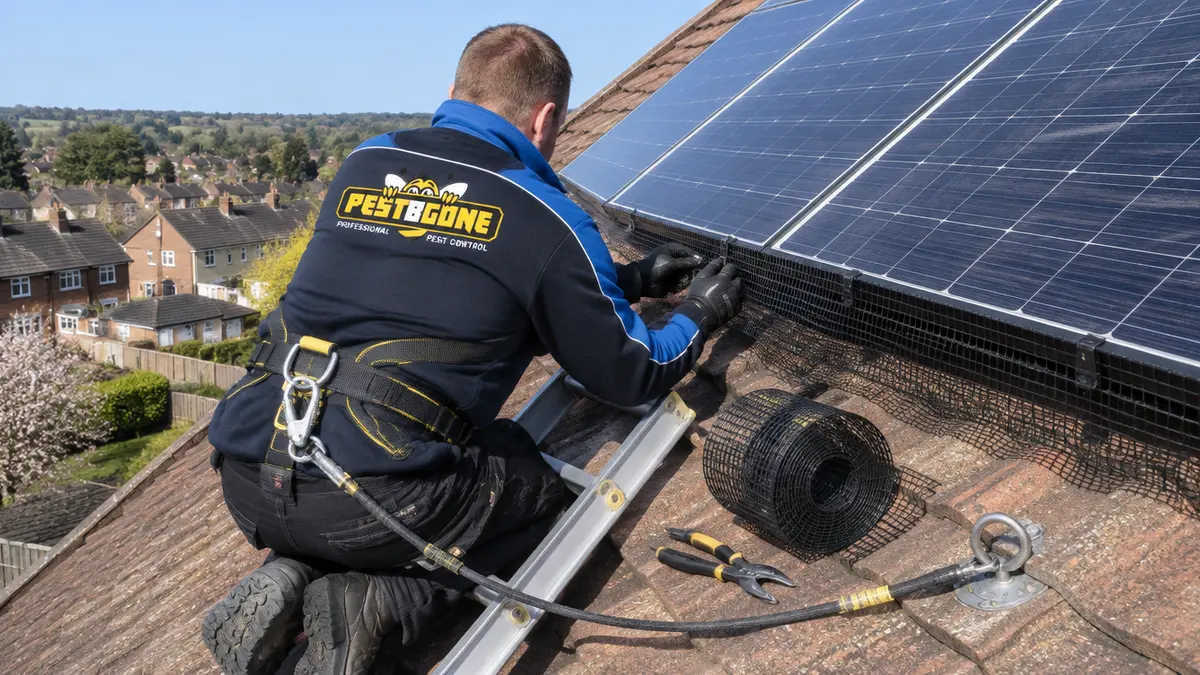
How the proofing works. A black, UV-stabilised mesh is fitted around the full perimeter of the array, sealing the gap between the panel frame and the roof surface. It is secured with clips designed for the panel frame, not with screws, drills or adhesive on the panels or the roof covering. That matters for three reasons: it does not penetrate the roof, it does not interfere with the electrical installation, and it does not involve drilling into the panel frame. We describe the method so you can check it against your panel manufacturer's and installer's own warranty conditions; we are not the party who can tell you what your warranty allows.
Before proofing. Existing nesting material and fouling under the array are cleared and the area disinfected, with the correct respiratory protection. Proofing over an active nest is unlawful and proofing over old nesting material traps the problem in place.
What it looks like. From the street, very little. The mesh sits flush to the panel edge and is barely visible against the frame. It does not shade the panels.
Access and safety. This is work at height on a pitched roof with a fragile, electrically live installation on it. Nobody walks on solar panels, and nobody fits proofing from a ladder leaning on the array. We use the right access equipment for the roof.
Solar arrays are one part of it. For commercial and domestic buildings more widely, the right system depends on the species, the surface and the pressure.
| System | Best for | Notes |
|---|---|---|
| Stainless steel spikes | Ledges, sills, parapets, gutter edges, signage | Stop landing; do not harm birds; near-invisible from ground level |
| Post and wire | Long ledges and parapets where a discreet finish matters | Sprung wire between posts makes the ledge unstable to land on |
| Netting | Enclosing whole areas: loading bays, canopies, plant rooms, light wells, courtyards | Stainless fixings, correct mesh size for the species, tensioned so birds cannot get behind it |
| Solar panel mesh | Rooftop PV arrays | As above |
| Roofline proofing | Soffits, fascias, tile gaps, chimney pots | Closes the gaps starlings, sparrows and jackdaws use |
| Deterrents | Sites where physical proofing is not practical | Discussed case by case; we are honest about what does and does not work long term |
Every system is specified on survey. A proofing job that is fitted to the wrong specification, or to a ledge that still has an unproofed alternative six feet away, moves the problem rather than solving it.
A site survey identifying the species, the roosting and nesting points, the pressure and the lawful options
A written specification and quote
Clearance and disinfection of fouling and nesting material where required, by technicians with the correct respiratory and protective equipment, with waste removed from site
Installation of the specified system by trained technicians using the correct access equipment
Solar panel mesh fitted with frame clips, no drilling into panels or roof covering
Checks for active nests before any work, and a lawful schedule if one is found
Written records, photographs and, for commercial clients, a maintenance recommendation
Tell us the building, the birds and where they are getting in or landing. Photographs from ground level are useful. Do not go onto the roof to take them.
A technician inspects the site, identifies the species and the pressure, and checks for active nests. You receive a specification and a quote.
Fouling and nesting material are cleared and the area disinfected, then the proofing is installed. A typical domestic solar array takes two to four hours; a large commercial array can take two or three days.
You get photographs of the finished work and, for commercial sites, a recommended inspection interval. The materials carry their manufacturers' warranties, and if something we fitted is not doing its job, call us and we will come back and look at it.
Outside the nesting season, or before it starts. Feral pigeons can nest year-round but peak from spring to late summer; gulls nest from April to August and are protected on the nest throughout; starlings and sparrows nest from March. The best time to proof a solar array or a roofline is late autumn to early spring, when nests are empty and the work can be done without delay. If you are reading this in June with an active nest, the honest answer is that we survey now, plan the work and book it for the moment the nest is finished.
For warehouses, retail parks, food manufacturers, hotels, schools, car parks and managed residential blocks, bird activity is a hygiene, safety and maintenance cost as much as a nuisance. A loading bay with a roosting flock fails a food safety audit. A fire escape with fouling on the treads is a slip claim waiting to happen. A flat roof with gull nests has blocked outlets by August.
We survey, specify and install for commercial sites across both regions, and we can inspect and maintain proofing on an ongoing basis under our commercial pest control service.
Heavy fouling on roofs, walkways, plant rooms and loading bays is cleared and disinfected as part of our hygiene cleaning and decontamination service.
Southeast hub
Buckinghamshire, the Thames Valley, Hertfordshire and London
Southwest hub
Bristol, Gloucestershire and the South West
Call your local team or send us the details and we will call you back.
We use cookies to make this site work and, with your permission, to understand how it is used. You can accept all cookies, reject non-essential cookies, or manage your preferences.